
Commercial field hardware engineered to operationalize CCME Section 5.5.1, US EPA and many other jurisdictions guidance. Replaces variable headspace bag testing with automated optimization, equilibration and AI-driven lab correlation.
%20(1).png)
The AISCT Aurora System provides AI-integrated vapour screening for volatile organic compounds (VOCs), chlorinated VOCs (CVOCs), BTEX compounds, and gasoline-range hydrocarbons in soil. It replaces the conventional headspace bag method with a fully standardized, reproducible, quantitative process aligned with CCME Section 5.5.1 guidance.
Aurora is designed to be deployed from Day 1 of a site investigation. As the site data set grows, the AI model's predictive accuracy increases — building a continuously improving correlation to laboratory data that enhances delineation, threshold-setting, and remediation performance tracking throughout the programme.
Speak with our experts & book a demonstration.
Request Demo / Order Equipment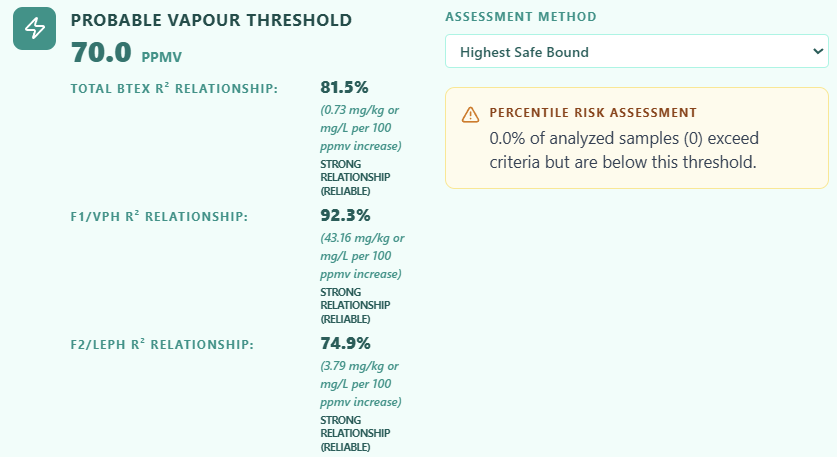
Conventional OVA/PID and headspace bag methods fail for three interconnected reasons:

Aurora addresses each of these root causes:

Aurora was developed in direct alignment with published regulatory guidance such as:

Headspace Vapour Tests: Aurora operationalizes and significantly advances the headspace vapour method endorsed in CCME guidance

QA/QC: Aurora generates automated calibration records, bump tests, blanks, duplicates, and triplicates consistent with CCME data quality objectives

Phased Investigation: Aurora supports all phases from Phase II through delineation and remediation confirmation

field analytical methods: consistent with EPA recommendations for structured, reproducible field screening approaches
A comparative field study involving 62 samples — 31 with laboratory confirmation —demonstrated Aurora's superior correlation to laboratory-measured TPH and BTEX compared to conventional HSVL bag methods. Traditional bag methods showed limited and inconsistent correlation. Aurora's AI-driven approach produced statistically defensible field-lab correlation across the full concentration range encountered on site.
Download the Aurora Technical Bulletin.png)

Temperature-controlled headspace vapour extraction with AI predictive modeling
VOCs, CVOCs, BTEX, gasoline/diesel-range hydrocarbons (F1 fraction and volatile F2)
30–35°C (controlled and logged)
Automated calibration records, bump tests, blanks, duplicates, triplicates
Real-time field results, exceedance flags, confidence metrics, DSS-integrated dataset
CCME Vol. 1 Sections 2.2, 3, 5.5.1; EPA field analytical guidance
Day 1 of site investigation; all investigation phases
All OVA-driven hydrocarbon sites regardless of phase
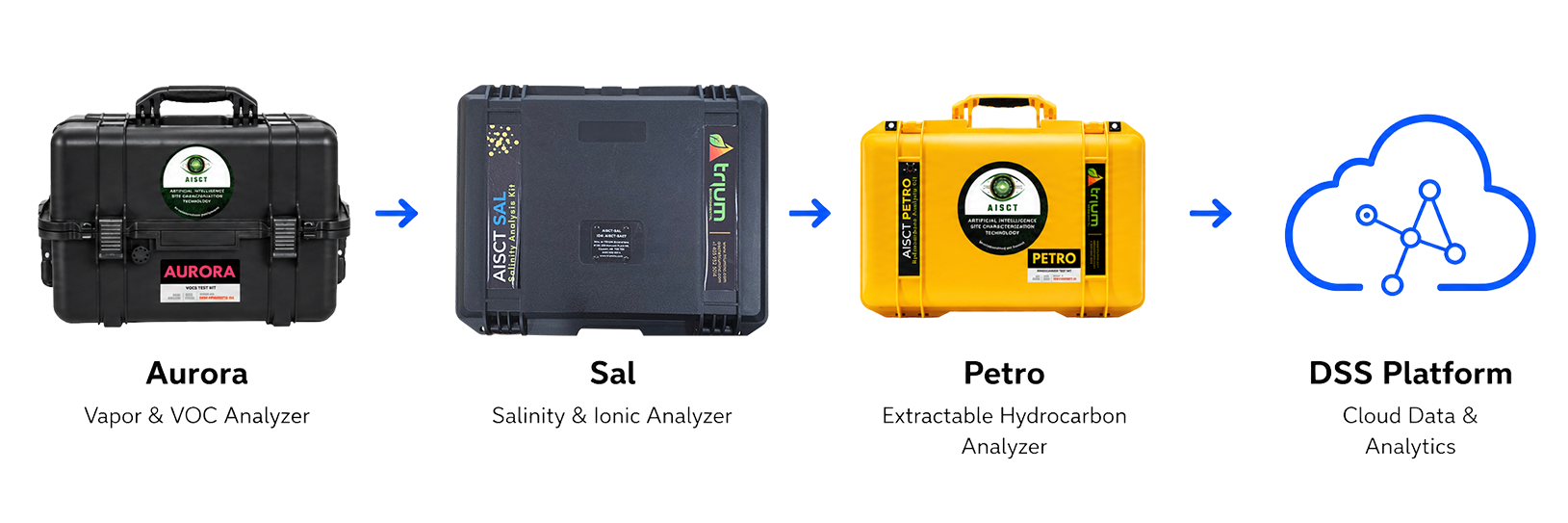
AISCT components can be deployed individually — Aurora on a vapour-driven hydrocarbon site, Sal on a brine release, Petro on a peat-heavy extractable HC programme. But they are designed to work together. When multiple contaminant classes are present on the same site, a multi-unit deployment produces an integrated dataset that no single instrument can provide.
The DSS platform is contaminant-agnostic: it ingests data from whichever units are deployed, maintains a unified site data record, and provides cross-contaminant intelligence that is invisible when instruments operate independently.

Ready to Transform Your Field Characterization? Request a demonstration or order AISCT® hardware for your upcoming field program.