AISCT®

The Industry Had the Roadmap. It Just Didn't Have the Tools. Until Now.

For decades, regulatory guidance from the U.S. EPA, CCME, and CSA Group has described a better way to characterize contaminated sites. The guidance is clear: use high-density sampling, structured QA/QC, data-driven decision-making. The industry understood. But the tools available in the field were not designed to execute it.

This page explains why the conventional tools are insufficient — not as a criticism of the professionals who use them, but as an honest look at what the data shows. And it explains why re-engineering from first principles was the only path forward.

The Problem:

Conventional Field Screening Was Never Designed for Certainty

Traditional field screening instruments — OVA/PID detectors, headspace vapour bag methods, and bulk electrical conductivity meters — were valuable innovations when they were developed. But they share a fundamental limitation: they were designed for detection and triage, not for decision-grade data.

Vapour Screening (OVA / PID / Headspace Bag Methods)

Reported correlation to laboratory data: typically below 25%, often below 10%
Sources of variability: inconsistent headspace volumes, uncontrolled equilibration temperatures, bag integrity, variable sample handling, and operator technique
CCME Guidance Manual, Section 5.5.1 acknowledges headspace vapour methods as arecognized field tool but explicitly notes the variability inherent in non-standardized approaches
U.S. EPA documentation confirms that spatial heterogeneity alone introduces approximately 19x more variability than analytical method selection — meaning sparse, variable screening data cannot resolve the site in any statistically meaningful way

Salinity / EC Meters

Bulk electrical conductivity meters measure total dissolved ion load — not the specificions that regulatory guidelines target
EC readings are sensitive to moisture content, soil mineralogy, temperature, and background mineral interference — factors that are highly variable in the field
The result: EC-based field screening frequently misclassifies samples, producing false positives in background areas and missing true impacts in high-matrix environments
Alberta Tier 1 and CCME guidelines specify chloride and sodium — the specific parameters EC cannot reliably speciate

PHC / Extractable Hydrocarbon Screening

Vapour-phase PHC proxy methods (PID, bag testing) are sensitive to compound volatility, temperature, and moisture — creating systematic bias across volatile and semi-volatile fractions
Peat and high-organic environments introduce severe biogenic interference, producing readings that cannot be distinguished from true petroleum contamination without laboratory confirmation
Correlation to laboratory semi-volatile and heavy hydrocarbon results: consistently below25% for conventional methods

The Root Cause: Heterogeneity and the Sampling Paradox

Contaminated sites are not uniform. Soil varies by texture, moisture, organic content, and contaminant distribution at a spatial scale that conventional sparse-sampling programmes cannot capture. This is not a new insight — the EPA, CCME, and CSA Group have all documented it extensively.

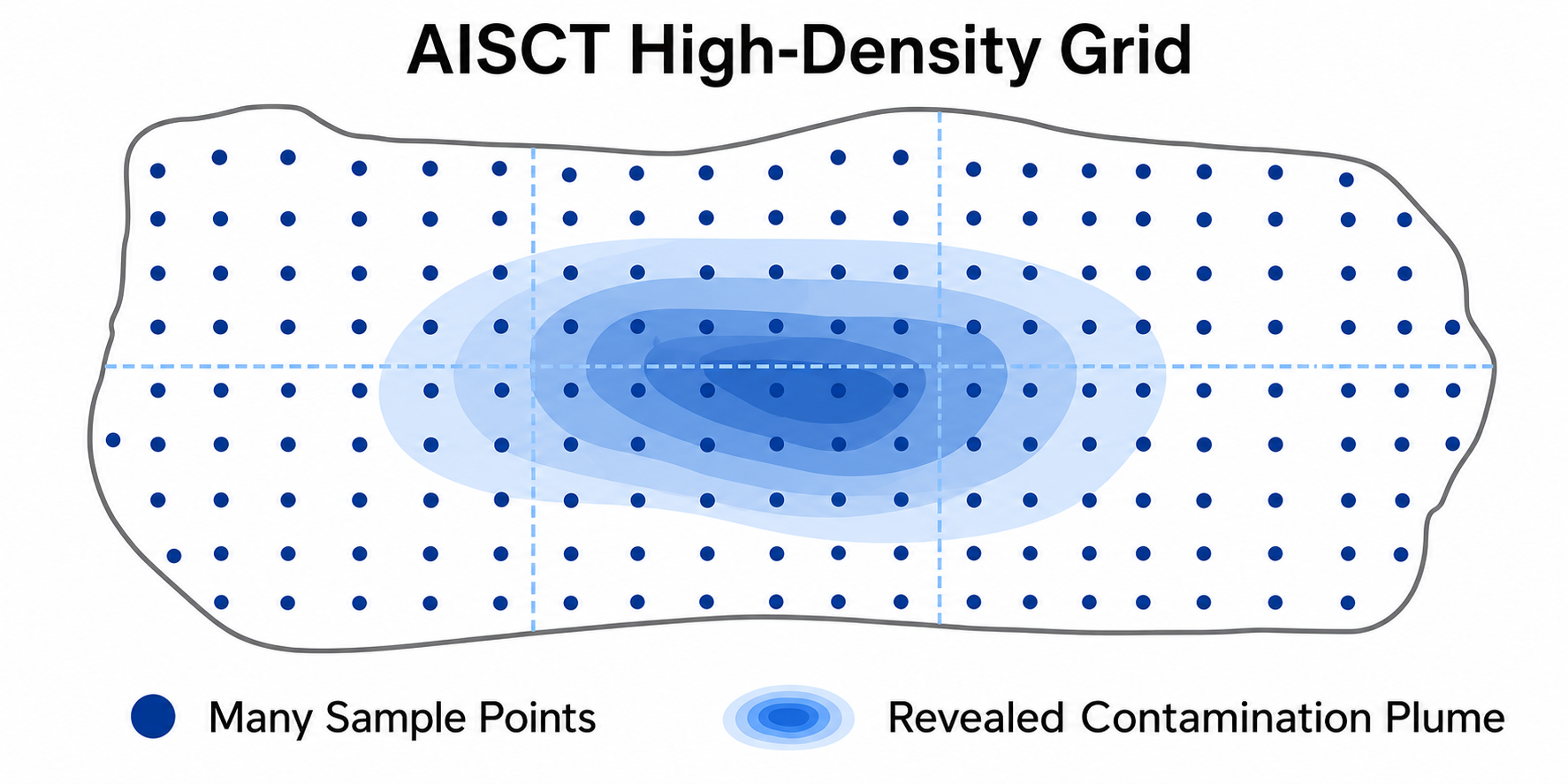
AISCT was engineered to break this paradox. By dramatically increasing the throughput and reliability of field data, AISCT enables the density of measurement that heterogeneous environments actually require.

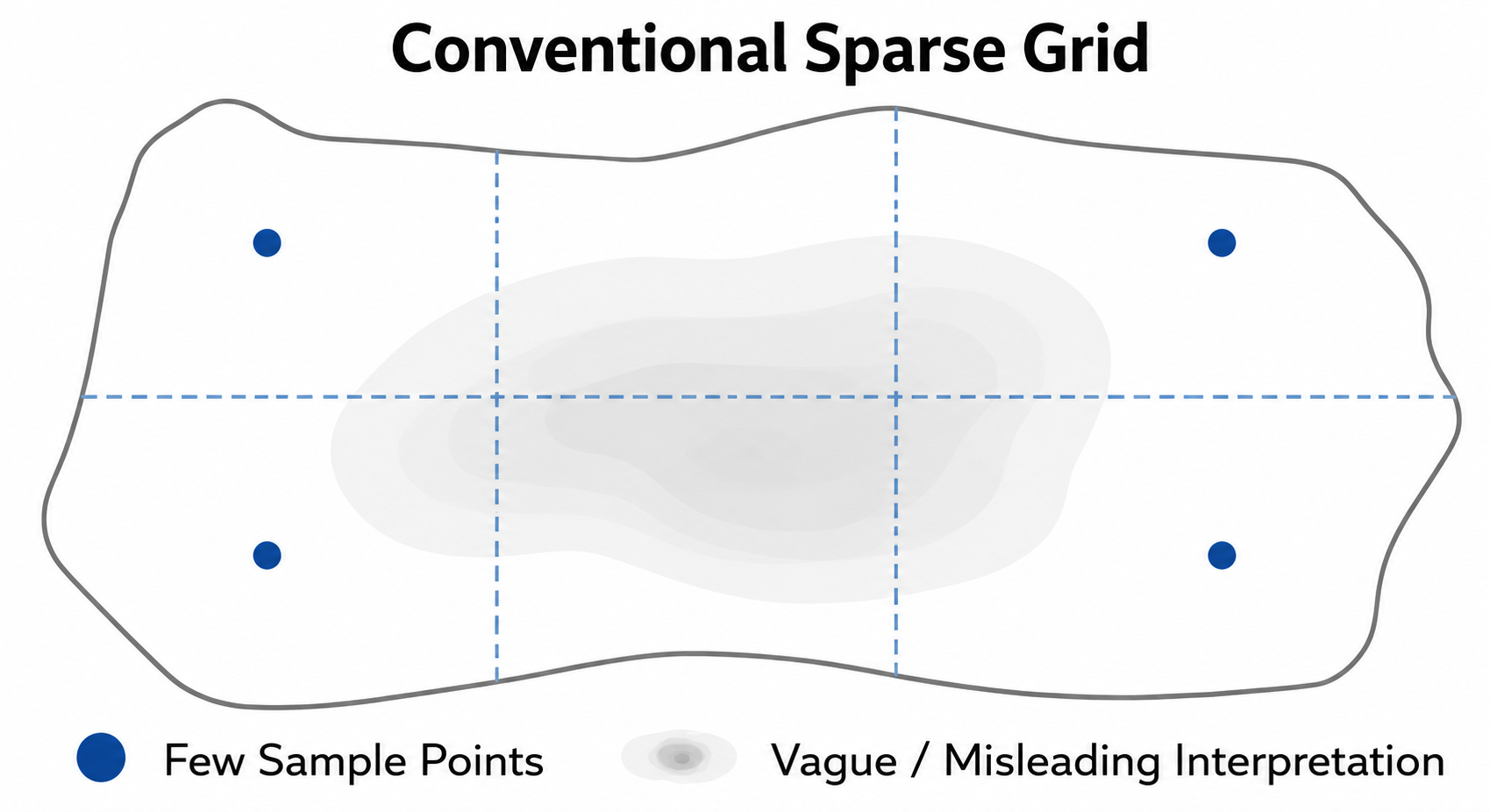
The Sampling Paradox

The sampling paradox is this: the more variable a site is, the more data you need to characterize it with confidence — but conventional programmes, constrained by cost and the throughput of field instruments, collect less data at the sites that need it most.

Sparse Sampling Misses what Dense Sampling Reveals

Same Footprint. Two different levels of certainty.

The Value Inversion Problem

Conventional practice has inverted the logic of environmental site work. When cost and time are treated as the primary constraints, certainty suffers. And when certainty suffers, the true costs compound:
re-mobilizations, failed regulatory audits, over-excavation of clean soil, missed contamination, extended closure timelines, and liability.

The AISCT approach begins from the opposite premise: certainty first. When high-density, decision-grade data is available from day one of a programme, scope decisions are better, excavation boundaries are defensible, sampling selections are statistically justified, and closure audits succeed.

AISCT® Approach: Certainty

When high-density, decision-grade data is available from day one, scope decisions improve, sampling selections are statistically justified, and closure audits succeed.

Smarter Scope Decisions
Defineable
Boundaries
Justified Sampling
Successful
Closure

Key Insight

Value in environmental site work is not created by having a tool on-site. It is created by the decision made using data that would not otherwise have been available. AISCT creates theopportunity for value. The professional in the field decides what to do with it.

AISCT® Created the opportunity for value. The professional in the field decides what to do with it.

What Re-Engineering Required

Redesigning field screening from first principles meant addressing each source of variability atthe instrument level:

Controlled extraction conditions:

Standardized sample volumes, temperature-controlled headspace, fixed equilibration protocols

Ion-specific measurement:

Replacing bulk EC with ion-selective electrode arrays targeted to chloride — the regulatory parameter

Solvent- extraction methodology:

Mirroring laboratory extraction techniques in the field to capture extractable fractions rather than volatile proxies

AI integration:

Building predictive models trained on thousands of lab-confirmed datapoints to interpret field readings in terms of laboratory-equivalent outputs

Connected data platform:

Aggregating all field data in real time, enforcing QA/QC protocols, flagging anomalies, and producing reports that meet regulatory data quality objectives

Want to see how AISCT® supports decision-grade site characterization?

Artificial Intelligence Assisted Site Characterisation Technology (AISCT®) Rapid Soil & Water Analysis
Establishing AISCT®

Years of Pioneering Innovation & Advancement

Establishing AISCT®

View Full History