Replaces bulk electrical conductivity (EC), quantabs, and titration methods meters with precision Ion-Specific probes. Directly measures chloride (Cl⁻) and sodium (Na⁺) to provide demonstrating field to-lab data correlation exceeding 90%."
.png)
The AISCT SAL System provides AI-integrated, ion-specific salinity screening for chloride (with sodium capability in development) in soil and water samples. It is designed for all phases of investigation and remediation on salt-impacted sites, including produced water releases, brine spills, road salt programmes, and industrial salt-release scenarios.
Sal employs a precision array of Ion Selective Electrodes (ISE) targeted specifically to the ions that regulatory bodies and laboratories actually measure — delivering matrix-independent, ion-specific field data with decision accuracy exceeding 90%.
Speak with our experts & schedule a demonstration.
Request Demo / Order Equipment.png)
.jpg)
EC meter limitations in salinity characterization:

Sal's Ion Selective Electrode approach:

Aurora was developed in direct alignment with published regulatory guidance such as:

Salinity Parameters: Sal supports field-based screening against Alberta Tier 1 chloride and sodium criteria for upstream oil and gas scenarios

Sal generates field data interpretable against CCME national benchmarks for chloride and salinity

Requirements for the handling, treatment, reuse, and disposal of oilfield wastes

QA/QC: Sal incorporates automated calibration records, standard checks, and

Chloride (Cl⁻); sodium (Na⁺) capability in development
Precision Ion Selective Electrode (ISE) array — ion-specific, not bulk EC
>90% classification accuracy vs. laboratory data
Soil and water
Automated calibration records, standard checks, step-down protocols, duplicates/triplicates
Alberta Tier 1, CCME CSQG, AER Directive 085
All phases of salt-impacted site investigation and remediation
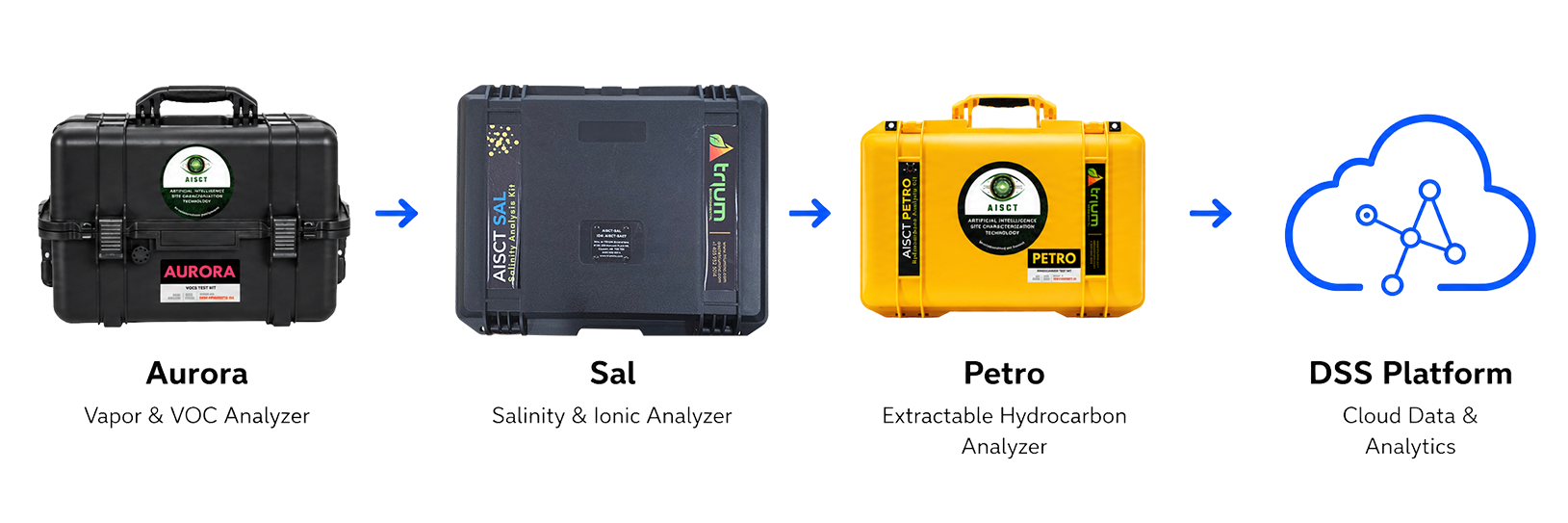
AISCT components can be deployed individually — Aurora on a vapour-driven hydrocarbon site, Sal on a brine release, Petro on a peat-heavy extractable HC programme. But they are designed to work together. When multiple contaminant classes are present on the same site, a multi-unit deployment produces an integrated dataset that no single instrument can provide.
The DSS platform is contaminant-agnostic: it ingests data from whichever units are deployed, maintains a unified site data record, and provides cross-contaminant intelligence that is invisible when instruments operate independently.

Ready to Transform Your Field Characterization? Request a demonstration or order AISCT® hardware for your upcoming field program.