The Foundation
Why the EPA TRIAD Changes Everything
Environmental decision error comes from three fundamental sources identified in US EPA Triad framework guidance:

Analytical Measurement Uncertainty:
Error introduced by instrument instability, ambient temperature swings, and unstandardized measurement conditions.

Operator and Procedural Error:
Variability in sample mass, headspace volume, extraction timing, and technique across different field technicians.

Environmental Variability:
Spatial heterogeneity in soil chemistry, geology, and contaminant distribution across the sampling area.
Conventional field screening struggles because qualitative tools fail to address all three sources simultaneously. AISCT was engineered to systematically resolve all three:

Analytical Uncertainty
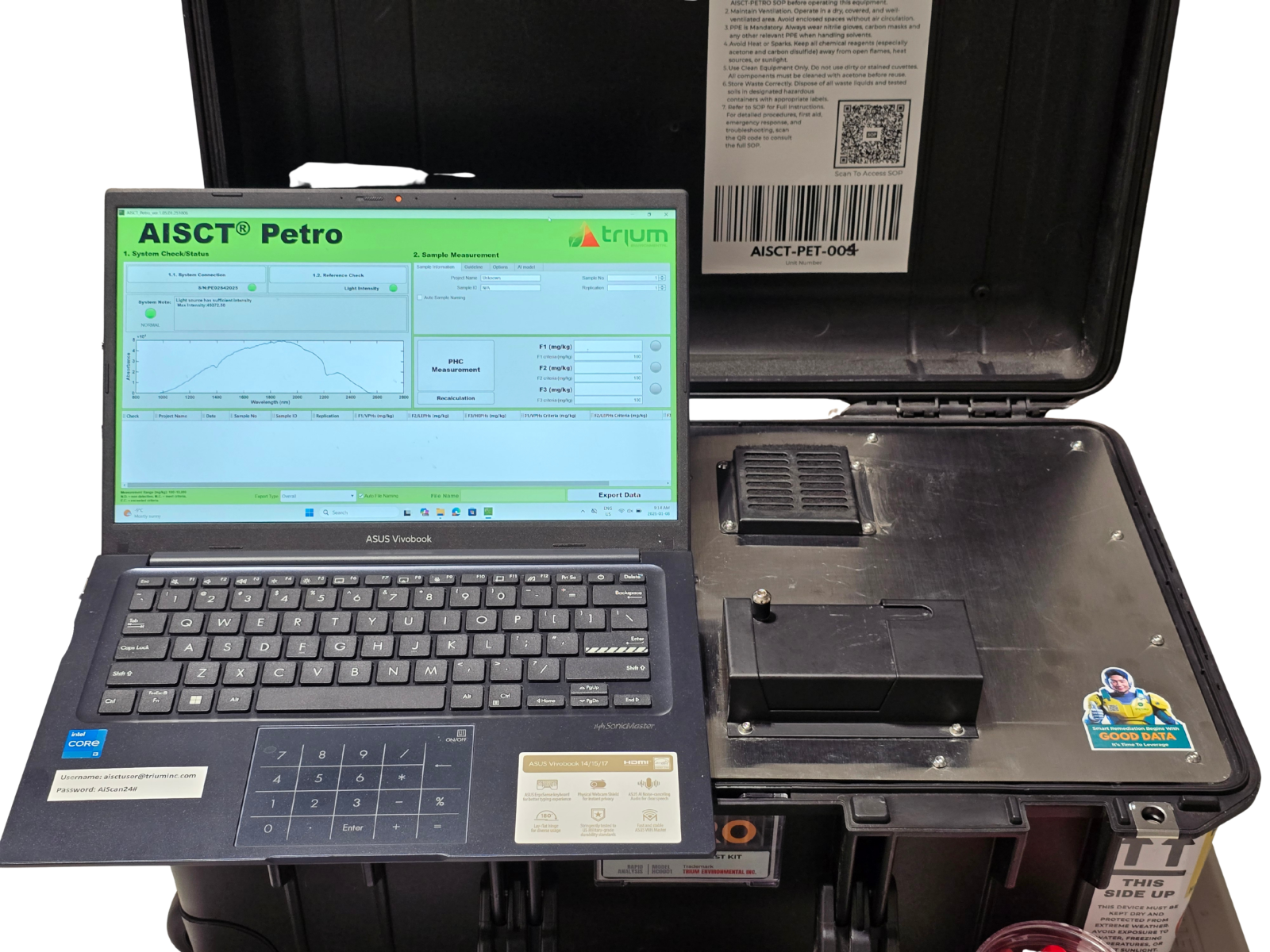
Minimized by standardized, hardware-controlled extraction and measurement conditions. The Aurora System's sample optimization, Sal System's precision ion probe array, and Petro System's solvent extraction protocol eliminate instrument-level variability.

Operator Error
Minimized by guided protocols within the DSS App. Calibration, sample preparation, step-down procedures, and QA/QC checkpoints are prompted and enforced in real time.

Environmental Variability
Captured through high-density field screening. At AISCT® throughput, collecting 200 spatial data points instead of 20 ensures site heterogeneity is fully characterized rather than guessed at.
The Three Core Principles

Precision
Every measurement is generated underidentical, controlled parameters—same volume, optimized temperature, standardized protocol. Results are directly comparable sample-to-sample, site-to-site, and operator-to-operator.

Probability
High-density screening creates robust sample populations. Rather than evaluating an isolated sample in a vacuum, the DSS Cloud Engine evaluates spatial distributions to replace guess work with statistical confidence.

Prediction
Pairing field readings with laboratory analytical results builds a site-specific correlation model. Once established, the system accurately predicts laboratory outcomes from field data in real time, delivering instant decision capability.

.png)
.svg)
.svg)
.svg)
.svg)
.svg)
.svg)
.png)


.svg)
.svg)
.svg)
.svg)
.svg)