
Nothing Left Behind in Coarse Sand
A salt cleanup in coarse sand, screened against a 3,000 mg/kg limit. 45 samples on site, 28 sent to the laboratory to check the answers — and not one contaminated sample was missed


EXECUTIVE SUMMARY
On this cleanup the crew had to decide, load by load, which soil was over the salt limit and which was clean. Sal measured the salt on site and gave an answer in seconds. Twenty-eight of those samples were also sent to an accredited laboratory to check the calls. The laboratory agreed with 27 of the 28. Every sample Sal cleared came back clean, and nothing over the limit was missed. The one disagreement went the safe way: Sal flagged a sample the laboratory then returned just under the limit.
AT A GLANCE
45 samples screened on site • 28 checked against an accredited laboratory
1.THE CHALLENGE
The usual field tool for salt is a conductivity meter, which measures how well the soil conducts electricity. The problem is that everything dissolved in the soil affects that reading — natural minerals and moisture as much as contamination. In coarse sand, where salt travels fast and clean ground can sit right beside dirty ground, the meter is least reliable exactly where the line has to be drawn. A reading near the limit could mean contamination or could mean ordinary background, and nothing in the number tells you which. So the crew either digs out extra clean soil to be safe, or risks leaving contamination behind.
2.THE APPROACH
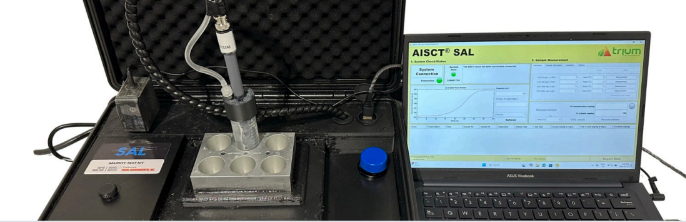
Sal measures the salt itself, not how well the soil conducts, and reports the answer in the same units as the cleanup limit. There is no calibration period and no waiting for the laboratory before the first decision — the crew reads a number and compares it directly to the limit. Laboratory samples still go in, but they play a different role: they check whether the calls were right, and every result that comes back is fed into the system so the next programme starts sharper than the last.
WHERE THIS RESULT APPLIES
- Salt cleanup in coarse, sandy or fast-draining ground
- Sorting loads for disposal while the truck is still there
- Confirming a dig is finished before the crew leaves
- Sites where digging out extra clean soil is expensive
3. THE DATA
Twenty-eight samples were measured on site and also sent to the laboratory, so those calls can be graded against a proper analysis. Sal tended to read a little high rather than a little low, which is the safe direction to be wrong on a cleanup. What counts is which side of the limit each sample landed on, and there the two agreed 27 times out of 28.
4.THE VERIFICATION
Sal cleared 26 samples and the laboratory confirmed all 26 — the half of the job that decides whether contamination is left in the ground. Its flagging was barely checked: of the 18 samples flagged, only 2 went to the laboratory, one over the limit and one 4% under it. Neither was a wasted dig, but two checks is not a track record, so the rating is held at Moderate rather than the Effective 15 of 18 would earn. That is a limit on what was checked.
5.THE DECISION
Because the answer is in the same units as the limit, the crew can act on it straight away instead of waiting on the laboratory. Every sample reading clearly above or below the limit was called correctly. The one disagreement sat close to the limit — the band where a laboratory check earns its cost.
6.THE VALUE
What this programme shows is not a saving — it is a track record that reports its own coverage. Sal cleared 26 samples and the laboratory agreed with all 26. Where fewer checks were sent it says so rather than filling the gap with a claim. A tool that tells you how much of its performance was verified is one you can put your name to.
BASIS & LIMITS — WHAT THIS CASE DOES AND DOES NOT ESTABLISH
- One cleanup, one ground type, one limit, 28 checked samples — a good indication, not a guarantee.
- Only 2 of the 18 flagged samples were checked and only 1 confirmed sample was over the limit, so the rating is held at Moderate.
- The extraction method and chemistry are proprietary. Field screening supports, and does not replace, accredited laboratory analysis.