
Twelve Holes Was Enough
Five days on site, 245 chloride samples, and a plume resolved in three dimensions while the rig was still working. The laboratory checked 67 of those calls and agreed with 64.


EXECUTIVE SUMMARY
The question was where the salt had gone — how deep, how far, and whether the budget would reach far enough to find out. 12 holes were advanced over 5 days and 245 chloride samples were screened at the rig as the core came up, to 20.5 m. The laboratory checked 67 of them and agreed with 64 — 95.5%, at an R² of 0.983. The crew did not wait for any of that: depth was closed out at every hole and lateral extent at all but one margin, inside the allocated programme.
AT A GLANCE
1.THE CHALLENGE
A chloride release has to be closed out in three dimensions, and conventional practice buys that one laboratory round at a time: drill, log, bag, wait two to three weeks, then return to drill where the last round said to. Every round is another mobilisation, so on a fixed budget the number of rounds is the number of answers — and programmes run out of money with the base of the plume still open. A conductivity meter does not fix it: it responds to everything dissolved in the soil, not the chloride.
2.THE APPROACH
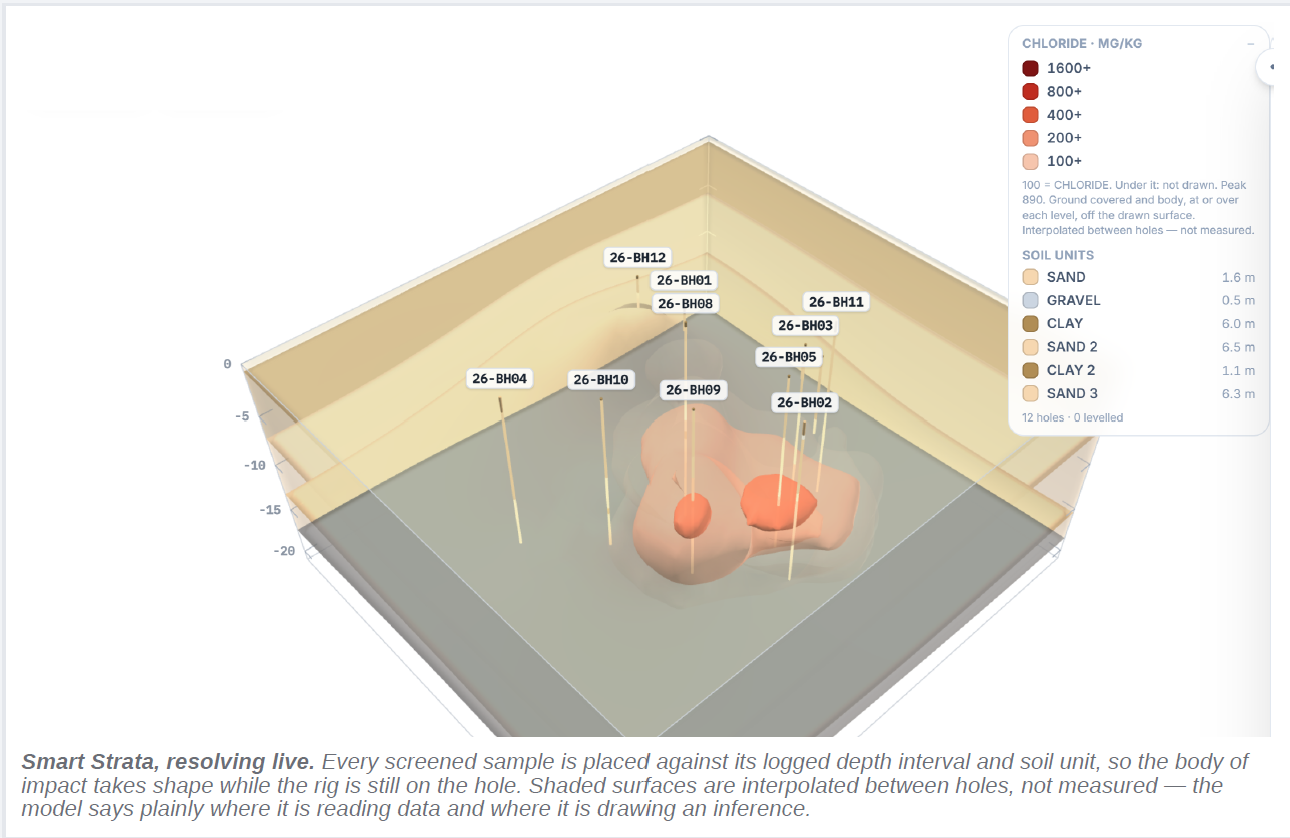
Sal measures the chloride itself and reports in milligrams per kilogram, so every result is compared against the 100 mg/kg limit at the moment it is recorded. Samples were run at the rig as the core came up — 61 on the first day alone — and each was logged against its depth interval and soil unit in the App. Those entries feed the Smart Strata model, which resolves on screen while the hole is still open, so the next decision was taken against the picture as it stood that morning.
WHERE THIS RESULT APPLIES
- Chloride releases that must be closed out in depth as well as in plan
- Programmes with one mobilisation in the budget and no second round to fall back on
- Sites where the next hole should be placed on what the last one said
- Ground layered enough that bulk conductivity cannot resolve the boundary
3. THE DATA
238 soil samples and 7 groundwater samples were screened over the 5 days, across sand and gravel over clay with sand again beneath. 146 of the 238 soil readings came back below the 50 mg/kg reporting floor — most of this site was clean, and the screen said so at the rig rather than a fortnight later. The 92 that carried a number ranged up to 6,018 mg/kg against a 100 mg/kg limit. Each reading was tied to a depth interval, so the vertical extent closed out hole by hole as the programme ran.

4.THE VERIFICATION
67 soil samples went to an accredited laboratory and 64 of them landed on the same side of the limit — 95.5%. The three that did not are worth naming. One read 99 mg/kg against a laboratory result of 115: a single percent below a limit the laboratory put fifteen percent above, and the system had already returned it at a 47% probability of exceedance rather than as a clean pass. One flagged at 151 mg/kg came back at 93. The third is a genuine miss — a sample returned below detection that the laboratory reported at 181 mg/kg — and it is counted as one.
Agreement on its own is not a grade. Every programme is placed in a confusion matrix against the accredited results and scored on nine fixed measures, with the two error types counted separately, so a screen that misses impact cannot hide behind a high overall accuracy. On this programme seven of the nine measures clear their Effective benchmark and two sit in the Moderate band. The system still caps its own rating at Moderate, because 32 of the 86 flags it raised were never sent for confirmation — a limit on what was checked, not on how it performed.
5.THE DECISION
Because the number arrives in the units of the limit, the hole in front of the crew was characterised before the rig moved off it. Depth was closed out at every location and the lateral boundary at all but one margin, inside the allocated budget — an outcome that conventionally takes two or three mobilisations with a laboratory turnaround between each of them. The decisions that mattered were taken on site, in the hour, by the people standing on the ground.
6.THE VALUE
245 samples in 5 days is throughput; the 95.5% agreement with the laboratory is what made the throughput worth acting on. Together they bought a delineated plume on a single mobilisation. The one margin left open is recorded as open — the programme knows what it did not close, which is the part a schedule cannot fake.
BASIS & LIMITS — WHAT THIS CASE DOES AND DOES NOT ESTABLISH
- 67 soil samples laboratory-paired against the 100 mg/kg criterion: 31 correct flags, 33 correct clearances, 1 false alarm and 2 missed. Measures and rating are as reported by the AISCT® platform and were independently reconciled against the project export.
- The rating is held at Moderate by the verification-bias override — 32 of 86 soil flags confirmed — not by any measure falling short. Closeness is reported as 1.28; recomputed on the 7 duplicate pairs carrying two quantified reads it is 1.57. Either figure bands Moderate, not Effective.
- One confirmed miss: a sample returned below the 50 mg/kg reporting floor came back at 181 mg/kg. One margin of lateral extent was not closed within the programme.
- 5 of 5 groundwater samples were flagged and confirmed over criteria. That is classification agreement only — field and laboratory concentrations are not equivalent on the water matrix and no numeric claim is made for it.
- Surfaces in the three-dimensional view are interpolated between holes, not measured. One site, one release, one ground sequence. The extraction chemistry is proprietary; field screening supports rather than replaces accredited laboratory analysis.