
When the Bag Method Says Nothing
Two vapour screening methods, run on the same soils with the same detector against the same laboratory results — and only one of them produced a number worth acting on.

EXECUTIVE SUMMARY
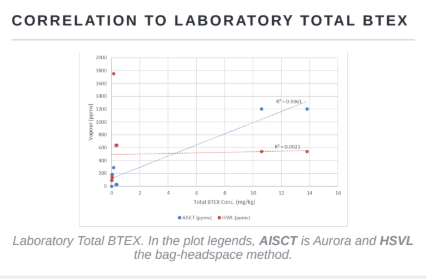
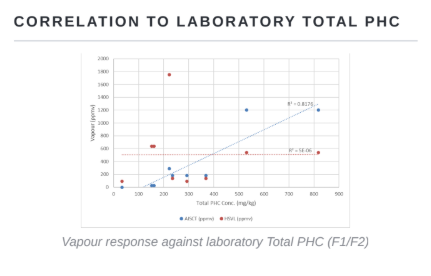
Conventional bag-headspace screening and the AISCT® AuroraTM standardised procedure were run side by side on the same soils, using the same photoionisation detector, and scored against the same accredited laboratory results. Aurora tracked the laboratory closely enough to predict the concentration — R2 0.94 against Total BTEX and 0.82 against Total PHC. The bag method, on those same samples, produced no statistically meaningful relationship on either parameter. Because the detector was held constant, the difference between the two is attributable to process control, not to sensor performance.
AT A GLANCE
62 samples screened by both methods • 31 laboratory-confirmed
1.THE CHALLENGE
A vapour reading is governed by variables the bag method does not control: headspace volume, equilibration time, sample temperature and operator technique. Each of them moves the number, and none of them is recorded. A morning reading is therefore not comparable to an afternoon one taken by the same crew on the same soil, so the readings cannot be read as a population at all. Published correlation to laboratory data typically sits below 25%, and often below 10% — a decision taken on that basis is not supported by the number used to justify it.
2.THE APPROACH
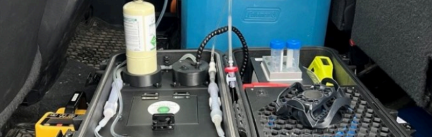
Aurora standardises the physics rather than the interpretation. Sample mass and chamber volume are fixed, equilibration is held at 30–35°C against an ambient range of roughly 10–27°C, and timing and agitation are automated so the procedure does not vary with the operator. Every reading is logged with the conditions under which it was taken and evaluated against a correlation model built from that programme’s own laboratory-confirmed pairs. For this study both methods used the same detector, so the comparison isolates the procedure.
3. THE DATA
Across the 31 laboratory-confirmed pairs, Aurora returned R2 0.94 against laboratory Total BTEX and 0.82 against Total PHC (F1/F2). Run on those same soils, the bag method returned 0.002 against Total BTEX and approximately zero against Total PHC. Aurora’s relationships are also quantitative: every 100 ppmv of vapour response corresponds to +1.11 mg/kg Total BTEX and +41.4 mg/kg Total PHC, so a response can be read back as an estimated laboratory concentration.
WHERE THIS RESULT APPLIES
- VOC and CVOC delineation where the excavation boundary is set on a vapour reading
- Stockpile segregation and step-out decisions taken while the crew is still mobilised
- Confirmation sampling where the threshold behind the call must be defensible
- Sites where a bag method has already produced data nobody will rely on
4.THE VERIFICATION
A significant slope is what turns a screening reading into a field decision. With one, a vapour threshold can be set at the concentration criterion and each sample called above or below it while the crew is still on the ground, supporting excavation extent, stockpile segregation and step-outs in real time. Without one, the reading can be described but not acted on, and the decision waits for the laboratory. [CONFIRM] Programme-specific decisions, volumes and schedule outcomes remain withheld pending client clearance.
5.THE DECISION
A significant slope is what turns a screening reading into a field decision. With one, a vapour threshold can be set at the concentration criterion and each sample called above or below it while the crew is still on the ground, supporting excavation extent, stockpile segregation and step-outs in real time. Without one, the reading can be described but not acted on, and the decision waits for the laboratory. [CONFIRM] Programme-specific decisions, volumes and schedule outcomes remain withheld pending client clearance.
6.THE VALUE
What this programme measured is the strength and significance of the field-to-laboratory relationship, and on that measure the two methods are not close. It did not measure cost or schedule savings, and none are claimed here. What is established is narrower and more useful: on these soils an Aurora reading predicts a laboratory number within a stated confidence and a bag reading does not predict one at all, so only one of the two can carry a decision that has to be defended later.
BASIS & LIMITS — WHAT THIS CASE DOES AND DOES NOT ESTABLISH
- 62 samples from a single site, 31 with accredited laboratory results; a larger programme or a different soil type could move these figures.
- Correlation models are programme-specific: the slopes reported here apply to these soils and this parameter set, not as a general Aurora calibration.
- Both methods used the same photoionisation detector, so the comparison isolates procedure rather than sensor selection; other bag-method variants were not evaluated.
- Field screening supports, and does not replace, accredited laboratory analysis.

.svg)